
They Just Wanted a Place to Swim: How People Changed The Riviera Club
Fred and Ellen Rice didn’t set out trying to change The Riviera Club.
They just wanted a place to swim.
In 1980, they were raising their family in Butler-Tarkington, just blocks from The Rivi. Their oldest son was two, Ellen was pregnant with their second and many of their friends and neighbors were members.
“We wanted to join,” Ellen remembers. “We wanted to go and enjoy the pool and enjoy hanging out with our friends.”
It seemed like the most ordinary thing in the world.
But they couldn’t join.
At the time, like many social organizations in that era, The Rivi had a long history of excluding people of color and people of certain religious and ethnic backgrounds. Fred is Black. Ellen is white.
Even finding the sponsors then required for membership consideration became an education for Ellen.
One neighbor had children who played with Fred and Ellen’s children. They belonged to the Rivi. The adults played cards and socialized.
But when Ellen asked them to sponsor them for Rivi membership, they refused.
“We lived two doors down, our kids played. We were social. And then they said, ‘No, I can’t do that,’” she remembers.
The neighbors, a white family, told them they feared retaliation if they sponsored an interracial family.
“That was eye-opening for me,” Ellen says. “So many things that I went through for the first time, of course, Fred had gone through his whole life.”
They found other friends willing to sponsor them.
Then they applied.
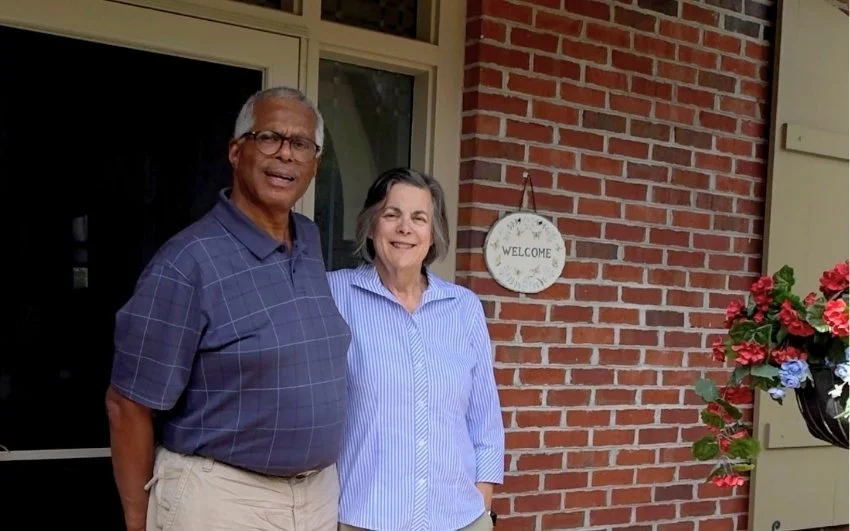
Fred and Ellen Rice, September 2026
A fight that had begun years earlier
By the time Fred and Ellen submitted their application, efforts to integrate The Riviera Club had been underway for years.
Community members began organizing around the Club’s membership practices in the early 1970s. Ethnically and religiously diverse families applied for membership and were rejected. In 1974, a federal lawsuit was filed challenging The Rivi’s discriminatory membership practices and its status as a private club.
The case would remain unresolved for years.
Then, on Memorial Day 1979, tragedy brought new attention and urgency to the issue.
Fifteen-year-old Dwight Eugene Jones, who was Black, went with white friends to swim at The Rivi but was not allowed in. The boys went instead to the nearby White River, where Dwight drowned.
His death intensified community pressure on The Rivi and became part of the larger effort to end the Club’s discriminatory practices.
By 1980, Fred and Ellen Rice became part of that effort.
Fred was an attorney. He and Ellen applied for membership, securing Rivi sponsors who were willing to support their application.
The Rice family was rejected.
They knew it was coming. In fact, being rejected was necessary for their experience to become part of the legal challenge.
None of that prepared Ellen for opening the letter.
“I sobbed. Oh my God, I sobbed,” Ellen remembers. “When I opened that letter, I sobbed.”
The depth of her own reaction surprised her.
“I thought, wait — this is 1980. I’m a good, upstanding citizen, and this is what’s happening.”
Then she thought about Fred.
“What made it extra sad was thinking, ‘Oh, this is what he’s gone through for 30 years. And his parents had gone through for 60 years.’”
For Ellen, one rejection became a window into an experience her husband and his family had lived with for generations.
“And I’m thinking, this is just one time,” she says. “I knew we were going to get the rejection letter, but for some reason, reading it — that was a huge education for me.”
Fred was deposed and later testified as part of the case. Ellen was supposed to be deposed, too.
Instead, she went into labor.
“I was having a child,” she laughed.
When the case finally reached court
By 1980, the controversy surrounding The Riviera Club was no longer confined to its membership or the neighborhoods around it.
There had been protests and picketing. Religious and community leaders spoke publicly against the Club’s exclusionary practices. The dispute received significant local news coverage.
The central legal question was whether The Riviera Club was sufficiently private to be exempt from the federal Civil Rights Act’s prohibition against racial discrimination in public accommodations.
When the case finally reached federal court in October 1980, witnesses described years of Black applicants being rejected from membership and Black guests being denied access.
Fred was among those who testified.
Before the court issued a decision, however, the two sides reached a settlement.
The Rivi agreed to open its membership to people of color. Changes were made to the membership process and several people involved in the lawsuit joined Club leadership, as stipulated in the setlement.
Fred became a member of the Board of Managers.
And the work of changing The Rivi continued from the inside.
“Nothing was business as usual.”
Fred remembers the Board of Managers at the time as a group of about seven or eight “older white men.” Several people connected with the lawsuit were added to the Board.
They weren’t simply there to attend meetings.
“Nothing was business as usual,” Fred says.
One membership practice quickly came under scrutiny.
Applicants had been required to physically appear at The Rivi to submit their membership applications.
“We all knew why they did that,” Fred says. “They wanted to see who they were dealing with.”
Changing that process took time.
“We would have discussions about, why are we doing this? Why have you been doing this?” Fred remembers saying.
Eventually, the in-person requirement disappeared.
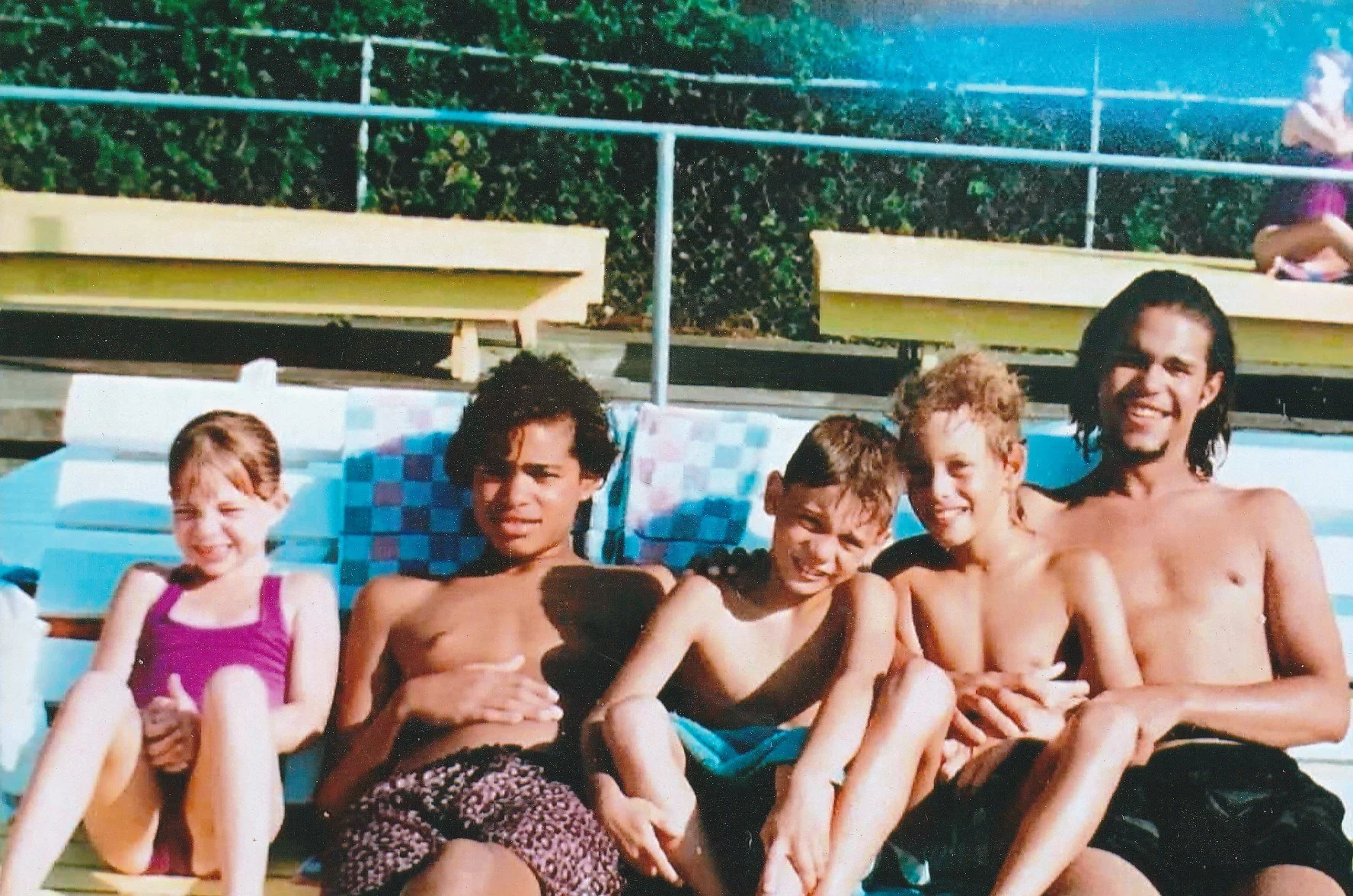
Friends pictured at The Rivi in the mid-1990s: Myra Pfingston Hinshaw, Edward Rice, David Marlowe, Ben Marlowe, Jack Rice (source: Fred and Ellen Rice)
Fred and Ellen remember something else about those early days after the settlement.
There had been fear that allowing Black families to join would fundamentally change The Riviera Club.
Then the Rice family started coming to the pool. So did other families.
And something rather ordinary happened.
“The pool was still full of kids, and people were still buying their ice cream bars or whatever, and life was going on,” Ellen says. All the fear surrounding what might happen if Black families were admitted had collided with reality.
Families went swimming.
“Here’s a huge change,” Ellen says, “and nothing changed.”
The family that just wanted to swim
Once they were members, Fred and Ellen began doing exactly what they had wanted to do in the first place. They went to The Rivi.
Ellen loved the water. Fred jokes that he was never quite the swimmer she was.
“She’s a water bug anyway,” he says.
While Ellen spent time at the pool with the boys, Fred spent much of his Rivi time doing the work of the Board.
Their sons, Edward and Jack, grew up at the Club. They swam, spent summer days with friends and, as they got older, rode their bikes to The Rivi by themselves.
Decades later, a third Rice generation is doing many of the same things.
Jack and his wife, Sarah, are Rivi members. Their children, Peter and Judith, attend Rivi Camp and take swim lessons. Edward now lives in Brooklyn and has two daughters of his own.
Fred and Ellen continue to use the Club, too. Ellen loves water aerobics. They have enjoyed dinners and events over the years and enjoy being with their grandchildren at The Rivi.
There is something remarkable in how ordinary all of that sounds.
Three generations of a family now belong to a place the first generation was once told they were not welcome.
“When Everyone Swims”
That history was part of the reason Ellen recently stood before Rivi Members and guests at a screening of the documentary “When Everyone Swims,” made possible by The Riviera Club Foundation and Heartland Film.
The film explores disparities in access to swimming and the people working to change them — a mission closely aligned with the work of the Foundation.
For the Foundation, swimming is more than recreation. It is a life skill. Its programs bring swim instruction and water safety education to children and families who may not otherwise have access to pools or lessons.
At a Club built around a swimming pool, that mission has particular meaning.
Ellen acknowledged the connection directly in her remarks before the screening.
“Those families, and their kids, who were excluded from coming to Rivi prior to 1980 were not able to benefit from what Rivi had to offer then and continues to offer today. A place where kids and families can be with their friends and neighbors, and where they can learn how to swim in a safe environment.”
Her own family ultimately did get that opportunity. “Needless to say, by becoming members, our two boys and their children learned how to swim the right way.”
The Foundation’s work today extends that opportunity far beyond Rivi membership, using the water that has always been at the center of the Club to serve children and families throughout the Indianapolis community.
Read more: Why “When Everyone Swims” Came to The Rivi →
The Rivi of Today
“Let me be clear, the way things were here at Rivi before 1980 is not the way things are now,” Ellen told the audience before the screening.
But she immediately added something equally important.“However, change did not happen overnight. In fact, change has been very slow, slower than we had hoped for back in 1980.”
Today, Rivi membership more closely reflects the diversity of the neighborhoods around us. But there is still work to do.
Some people know today’s Rivi.
Others know the stories about its past. Some come from families who were once excluded themselves.
Ellen has heard versions of the same response many times when encouraging people to consider joining: “Oh, we refuse to join Rivi because of their past history and policies.”
Her response is always the same.
“Fred and I, and the other families who worked to integrate the club, did so so you could and would join Rivi.”
Changing a policy can open a door. Changing a perception can take much longer.
And Fred doesn’t believe that happens simply by putting up a billboard announcing that things have changed.
It happens “people to peopleYou need to talk to your neighbors and know your neighbors and invite them in.”
“That’s why we’re here.”
Ellen does exactly that.makes a point of introducing herself to people she doesn’t recognize at the Club.
Recently at the pool, he approached a new interracial family with four young children. As they talked, Ellen shared some of The Rivi’s history.
The father was stunned. “1980?” he kept asking.
He had grown up in a different era and couldn’t believe something like that had happened so recently.
Then he explained why his family had joined The Rivi: Their friends had joined.
For Ellen, that was exactly the point.
“Good,” she told him. “That’s why we’re here. Please, bring your friends.”
More than 45 years after Fred and Ellen Rice simply wanted a place for their young family to swim, perhaps their story offers a lesson for where The Rivi goes from here.
Acknowledging the past doesn’t mean living in it. It means understanding the people who changed it and recognizing that the responsibility for what comes next belongs to all of us.
Toward the end of our conversation, Ellen shared a story that wasn’t specifically about The Rivi.
In their current neighborhood, a young, female neighbor once stopped Ellen while she was working outside and told her what a role model Ellen had been for her.
Ellen was surprised. “All I’m doing is just, we’re just trying to live good lives,” she says. “I didn’t know that could — just doing that — make an impact on somebody.”
Then she added: “Hopefully other people know that their lives impact others.”
People changed this place.
And people will determine what kind of place it becomes next.
__
Sources:
Interview of Fred and Ellen Rice, September 11, 2026, by Margaret Osborn
Ellen Rice’s address to crowd at September 3, 2026 screening of When Everyone Swims at The Riviera Club
Encyclopedia of Indianapolis — Riviera Club
Troubled Waters — The Court Case: Bates v. Riviera Club Inc.
Troubled Waters — The Riviera Club and Race Relations: 1933–1980
Troubled Waters documentary and research project
The Criterion — Oct. 31, 1980 Letter to Editor
